
When Exercise Stops Being Care and Starts Feeling Like a Test
Rethinking what movement is supposed to mean

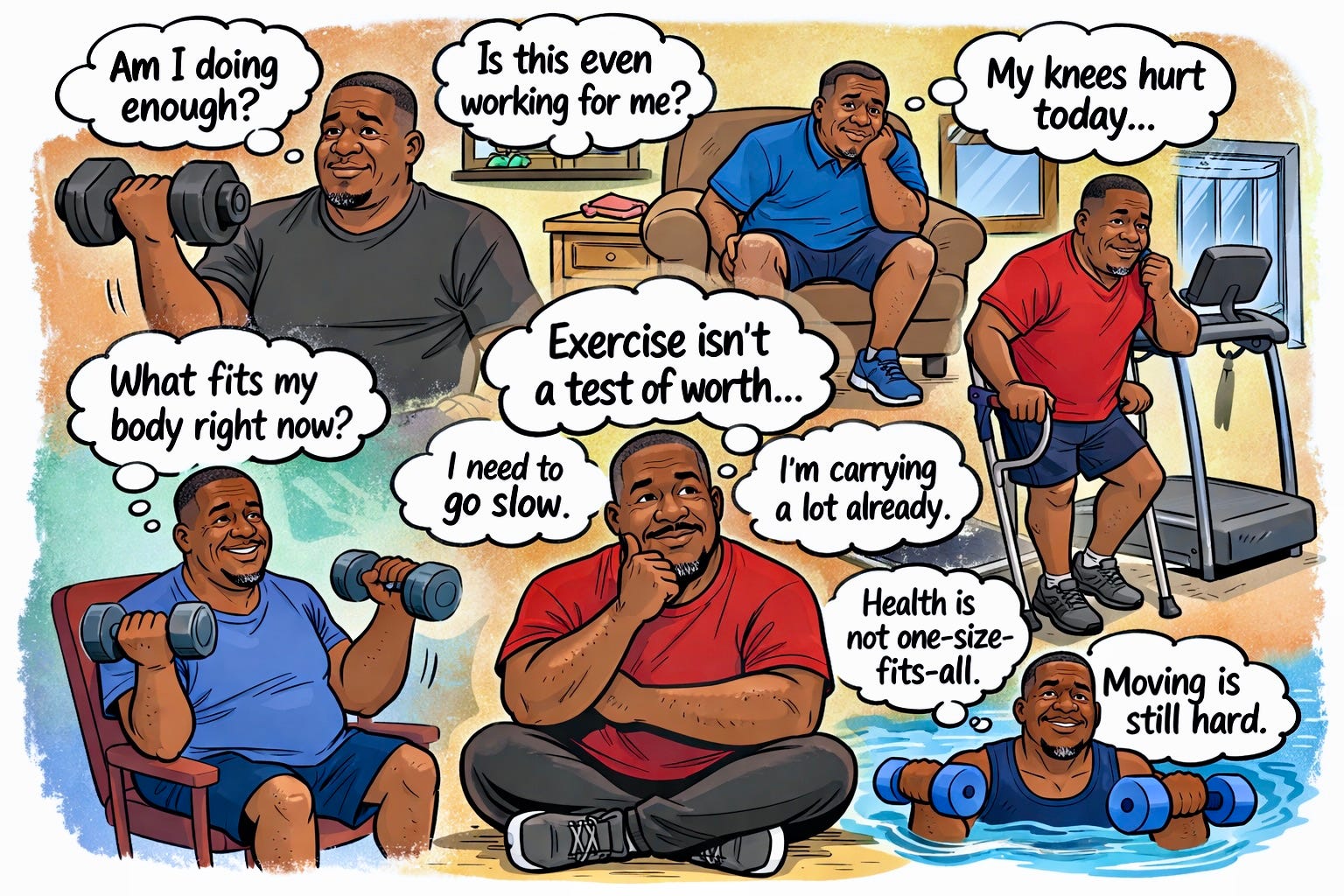
In my time online, I’ve noticed how loud the conversation around exercise has become.
Especially in health and GLP-1 spaces.
You hear things like:
You have to lift or you’ll lose muscle.
Cardio doesn’t count.
If your results stalled, you’re not doing enough.
You should be exercising at least 150 minutes a week.
For some people, that lands as motivation.
For others, something shifts quietly.
Exercise stops feeling like care.
And starts feeling like a test.
When Movement Starts Carrying Meaning It Wasn’t Meant To
Movement can support your body.
Mobility.
Stress.
Strength.
But it can also become something else.
A way to prove you’re doing this “right.”
A requirement for being taken seriously.
A measure of whether you deserve results.
Same activity.
Very different meaning.
And in the messy middle, that difference matters more than the movement itself.
The Question That Changes It
At some point, I had to ask:
Is the way I’m thinking about exercise helping me care for my body…
or helping me manage my fear about it?
That question doesn’t need a perfect answer.
But it does need honesty.
Because sometimes what looks like discipline is actually fear trying to stay in control.
What Gets Misread
A lot of people aren’t avoiding movement.
They’re avoiding what movement has come to represent.
Shame.
Judgment.
The feeling that effort is being measured.
Because once exercise becomes a test, it stops being something you can return to easily.
And a lot of people are stepping away from something that could help them…
because of what it has come to mean.
Where the Standard Breaks Down
There’s an assumption underneath a lot of fitness advice.
That bodies work the same.
That capacity is equal.
That access is shared.
It sounds like:
Everyone should be doing this.
There’s no excuse not to move.
That’s why it isn’t working for you.
But those statements don’t ask anything.
They assume sameness.
And sameness is not reality.
What Doesn’t Get Acknowledged Enough
Living in a larger body already requires effort.
More demand on joints.
More demand on the cardiovascular system.
More demand on movement itself.
That doesn’t mean someone shouldn’t move.
But it does mean:
movement is not starting from zero.
And a lot of people are being evaluated as if it is.
Fear Is Not a Plan
Movement matters.
Muscle health matters.
But fear is not a strategy.
And shame doesn’t build anything sustainable.
When movement is driven by fear, it becomes something you endure… not something you return to.
What Movement Can Be Instead
Movement doesn’t have to look intense to matter.
It can be:
Walking when you can.
Resistance when it fits.
Physical therapy.
Water.
Rest.
Daily life.
It still counts, even when it doesn’t look impressive.
The Part That Gets Overlooked
There’s a belief that if results don’t show up the same way, something must be wrong.
That someone didn’t follow through.
Didn’t try hard enough.
Didn’t “comply.”
But bodies don’t respond the same way.
They’re shaped by:
Genetics.
Hormones.
Medication.
Pain.
Stress.
Sleep.
Access.
So when outcomes differ, it’s not always failure.
Sometimes it’s just difference.
A Different Way to Look at It
Exercise is information.
Not a verdict.
It can support your life without defining it.
It can matter without becoming something you have to prove.
It can exist alongside inconsistency, limits, and fatigue.
None of that disqualifies you from care.
Reader Reflection
When you think about exercise right now, what shows up first?
Care?
Fear?
Pressure?
Proof?
For me, there were moments where movement felt more like something I had to prove than something I could return to.
If that’s shown up for you too, feel free to say it out loud here.
A Closer Place to Land
If this reflection resonates, the paid tier offers a closer, more conversational space to sit with these ideas a little longer.
No pressure. Just somewhere to stay present in it.
Ethical Note
This space reflects lived experience and thoughtful reflection with a touch of ai. It is not medical advice. Always consult a qualified healthcare professional for guidance specific to your situation.
Yeah, if we're comparing, I definitely wasn't moving during my active weight loss phase. The naysayers would likely frown upon it. It was so few & far between. I wanted to tho 🤷🏾♀️. But mentally, focusing on nutrition, meal prep, & correcting metabolic issues was all I had the capacity to focus on. I knew results may have been different, faster, better, blah blah blah. I didn't care. I knew that when I was mentally able to commit to that phase of self care, I would. So once I reached maintenance there was a shift & I was able to incorporate consistent exercise. Nothing is linear. But I view exercise as "care." It's my choice whether I do it once a week or 7-days a week. 🤷🏾♀️💜🫶🏾
Love this..." it still counts even if it doesn't look impressive" I have a friend who walks 8 miles a day and I can barely get in one. However that one mile is making a difference.